Introduction
Whether you’re designing industrial robots, medical equipment, or semiconductor machinery, understanding precision crossed roller bearings can help you optimize space, reduce costs, and boost reliability.
They deliver exceptional rigidity, compactness, and the ability to handle complex loads in a single unit.
At their core are cross rollers — cylindrical rollers arranged in a unique crisscross pattern at 90-degree angles. This design allows one compact cross roller ring to support radial, axial, and moment (tilting) loads simultaneously, making it ideal for applications demanding ultra-precise rotary or limited linear motion.
Before start the blog, we want to introduce us as the professional crossed roller bearings supplier in China. We offer types of crossed roller bearings with good price and good quality. You can rely on us about your application on crossed roller bearings.
What Are Precision Crossed Roller Bearings?
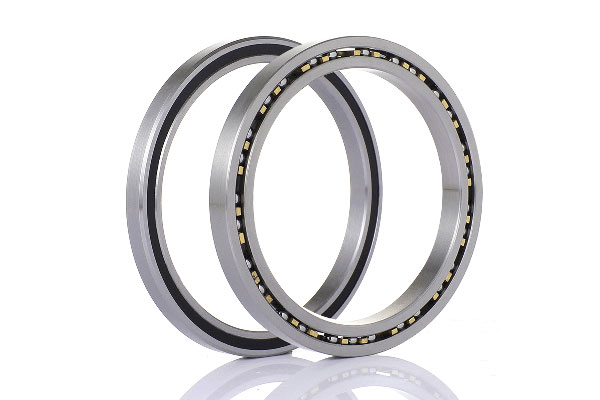
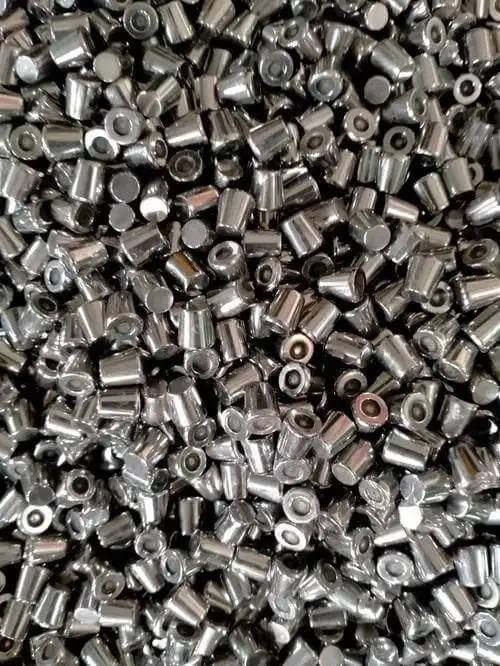
Precision crossed roller bearings (also known as cross roller rings) are high-accuracy rolling-element bearings that use cylindrical cross rollers instead of balls. These rollers are positioned alternately at right angles to each other between an inner and outer ring, typically in V-shaped raceway grooves.
Unlike traditional ball bearings, the cross rollers create line contact with the raceways, resulting in higher load capacity and minimal elastic deformation under stress. The cross roller ring structure is often split (e.g., two-piece outer ring) for easier mounting while maintaining high rigidity.
Key components include:
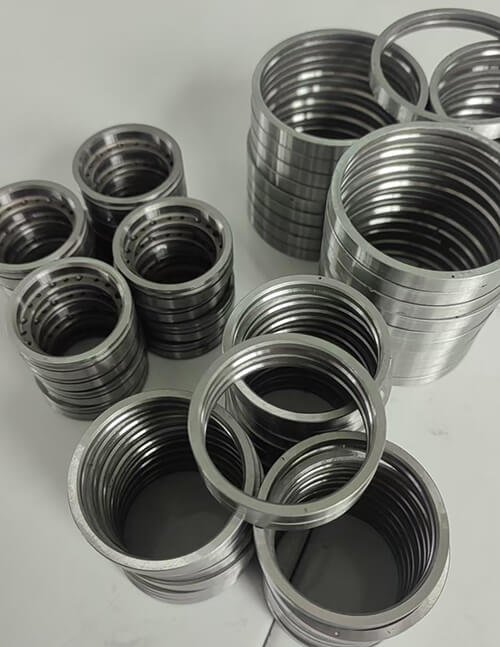
- Inner and outer rings with precision-ground V-grooves
- Cylindrical cross rollers (separated by spacers or cages to prevent contact)
- Optional seals for contamination protection
This orthogonal arrangement of cross rollers is what gives the bearing its name and unique multi-directional load-handling capability. One cross roller ring can often replace two or more conventional bearings, simplifying designs and saving space.
How Do Crossed Roller Bearings Work?
The magic lies in the 90° crossed configuration of the cross rollers. Imagine two sets of rollers working perpendicular to each other:
- One set handles loads in the radial and one axial direction.
- The adjacent set (crossed at 90°) manages the opposite axial and moment loads.
Because the rollers do not recirculate (unlike many linear ball systems), nearly all cross rollers remain under load at any time, providing consistent stiffness and smooth motion with very low friction torque.
In a cross roller ring, the rollers move along precisely machined raceways. Separators or cages keep them evenly spaced, preventing skewing and ensuring rotational accuracy down to microns. This setup excels in both rotary motion (common in turntables or robot joints) and short-stroke linear applications (crossed roller slides).
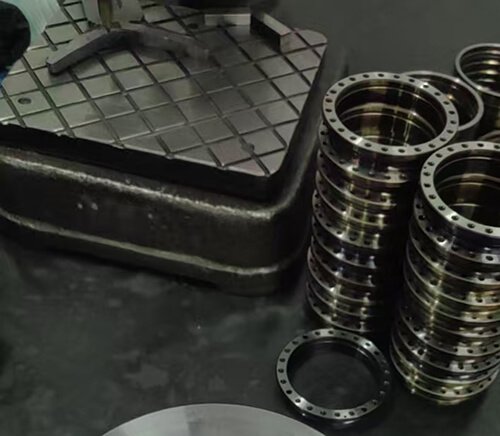
Precision grades ( P4, P2) further enhance accuracy, with some models offering negative clearance for maximum rigidity.
Key Advantages of Precision Crossed Roller Bearings
Cross roller rings and their cross rollers offer several benefits over ball bearings or traditional roller bearings:
- High Rigidity and Precision: Line contact and crossed design provide 3–4 times greater rigidity than equivalent ball bearings, with minimal deflection. Ideal for applications needing sub-micron accuracy.
- Multi-Directional Load Capacity: Handles radial, axial, and moment loads simultaneously in a compact form — one cross roller ring does the work of multiple bearings.
- Compact and Space-Saving: Slim profiles (some “super slim” types) allow integration into tight spaces without sacrificing performance.
- Smooth, Low-Friction Motion: Low starting torque and consistent friction reduce energy use and enable precise positioning, even in minute movements.
- High Rotational Accuracy: Excellent for indexing tables, spindles, and swivel mechanisms.
- Durability: Lower wear due to even load distribution among cross rollers.
Compared to ball bearings, crossed roller bearings offer higher load capacity and stiffness in the same envelope size. However, they may have slightly higher friction at very high speeds and require precise mounting surfaces.
Common Applications
Precision crossed roller bearings shine in industries where space, accuracy, and rigidity matter most:
- Industrial Robots and Automation: Robot joints and arms use cross roller rings for smooth, backlash-free rotation under varying loads.
- Machine Tools: Spindle heads, rotary tables, and indexing units benefit from high rigidity and precision.
- Medical and Life Sciences: Surgical robots, blood centrifuges, and lab equipment require clean, accurate motion.
- Semiconductor and Electronics: Wafer handling, pick-and-place systems, and cleanroom-compatible designs.
- Aerospace and Defense: Radar systems, satellite mechanisms, and lightweight swivel applications.
- Other: Food processing spindles, exoskeletons, optical instruments, and stretching film machines.
Popular series come from manufacturers like THK (Cross-Roller Ring), IKO, HIWIN, and others, with options for sealed, mounting-holed, or stainless-steel versions.
Choosing the Right Cross Roller Ring
When selecting a cross roller ring:
- Determine load types and magnitudes (radial/axial/moment).
- Consider size constraints and required accuracy class.
- Decide on roller guidance: cage/separator (for higher speeds) vs. full complement (for heavier loads).
- Factor in mounting (split ring for ease) and environmental needs (seals, lubrication).
- Compare with alternatives like angular contact ball bearings if cost or speed is critical.
Consult datasheets for torque, rigidity ratings, and life calculations. Precision crossed roller bearings often justify their cost through simplified assemblies and longer service life.
Conclusion
Precision crossed roller bearings, built around innovative cross roller rings and cross rollers, represent a smart solution for modern machinery demanding compactness without compromising on rigidity or accuracy. Their ability to manage complex loads in one unit reduces parts count, lowers assembly time, and elevates overall system performance.
Are you looking for crossed roller bearings in your projects? We can help you. No matter for standard or custom made crossed roller bearings.Please feel free to contact us.