
As the humanoid robot sector moves from concept to the verge of industrialization, a group of Chinese precision manufacturing companies are accelerating their entry into the market.
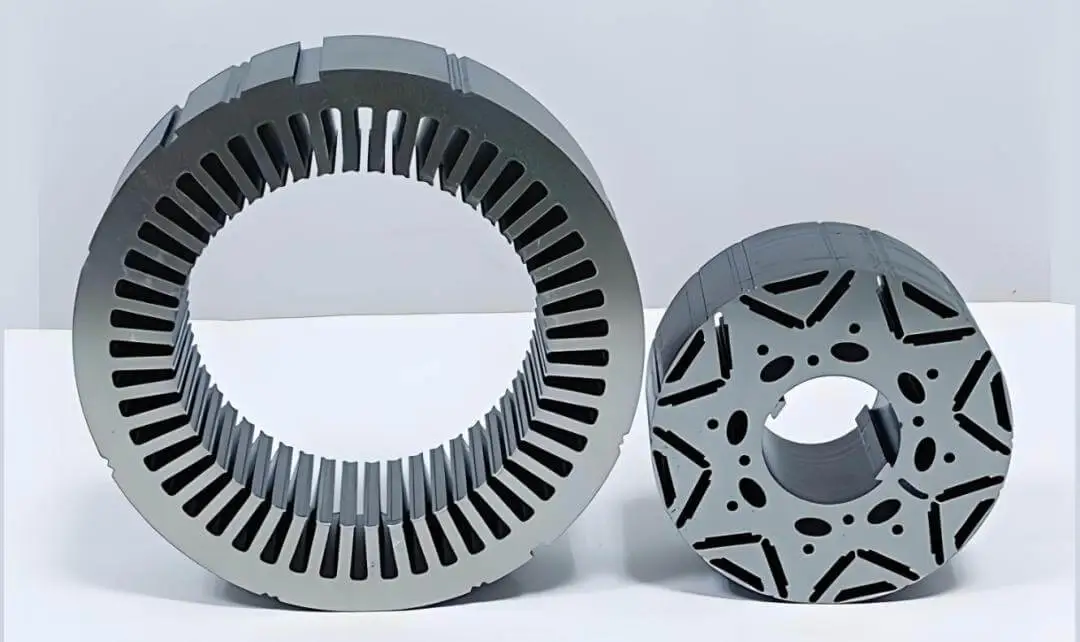
On the evening of December 23, Zhenyu Technology, a leading domestic manufacturer of motor cores, announced two major moves: it plans to issue convertible bonds to raise no more than 1.88 billion yuan, of which over 280 million yuan will be directly invested in humanoid robot projects; at the same time, the company plans to invest over 2 billion yuan in two key projects, making a significant foray into the fields of humanoid robots and the low-altitude economy.
This company, which started out making stamping dies, spent thirty years breaking the foreign monopoly in its field, and is now boldly investing heavily in the humanoid robot sector. Where does its confidence come from?
After conducting research on the humanoid robot, it was discovered that behind it lies a long-established company with 30 years of experience in precision manufacturing, launching an offensive towards the future.
From molds and motor cores to lithium battery structural components, Zhenyu Technology is now setting its sights on humanoid robots, which are considered the “next disruptive intelligent terminal.”

How will the strategic layout be supported?
At a time when the robotics industry is still in its nascent stages, this investment is undoubtedly a significant one. What’s particularly noteworthy is that Zhenyu Technology’s main revenue sources are still lithium battery structural components and motor cores.
In the first three quarters of 2025, the company’s revenue reached 6.6 billion yuan, with robot-related businesses accounting for a very small proportion. This strategic layout of “stable core business and aggressive expansion into emerging fields” demonstrates the company’s optimism and determination regarding future market opportunities.
The company’s development path is clearly visible. In its early stages, Zhenyu Technology started with molds for home appliance motor cores. Against the backdrop of the high-end mold market being dominated by foreign companies at the time, Jiang Zhenlin insisted on “steadily focusing on research and development,” leading his team to overcome one technical challenge after another.
In 2013, the company established Suzhou Fanster to enter the motor core business, extending its operations from molds to core components. In 2015, it accurately seized the development opportunities in the new energy vehicle sector, launched a lithium battery structural components project, and successfully entered CATL’s supply chain, forming a “one body, two wings” structure of “molds + motor cores + lithium battery structural components.”
Founded on the 30-year dedication of its founder, Jiang Zhenlin, to precision manufacturing, Zhenyu Technology went public on the ChiNext board in March 2021 at an offering price of 28.77 yuan. At that time, the company had already broken the foreign monopoly in the field of motor core molds, becoming one of the few domestic enterprises capable of independently developing and producing high-end motor core progressive dies.
Over the past thirty years, Zhenyu Technology has accumulated not only scale but also world-class precision manufacturing capabilities.
The company boasts over 300 high-precision machines, including Swiss Hauser coordinate grinding machines and Japanese Wasino optical profile grinding machines, with production workshops fully covered by a constant temperature and humidity environment. In terms of material selection, they collaborate with domestic and international upstream steel mills to customize and develop specialized raw materials. The overall positional accuracy of their ultra-precision motor core progressive dies is controlled within 0.005mm. Over 20 years of experience in heat treatment has resulted in a comprehensive process parameter system, providing core assurance for component stability. This technological foundation has become their “hidden trump card” in the field of humanoid robots.
Based on this foundation, in 2024, Zhenyu Technology officially launched its foray into the humanoid robot market.
In October, the company announced the establishment of Ningbo Martin Embodied Robotics Technology Co., Ltd., a wholly-owned subsidiary focused on the design and manufacturing of products in emerging fields such as humanoid robots. In December, a series of significant investments were finalized, totaling 3.88 billion yuan, demonstrating the company’s commitment to this sector.
According to the announcement, the project will be implemented by Ningbo Martin, with a construction period of two years. Upon completion and full production, it will have an annual production capacity of 210,000 sets of humanoid robot linear modules, 560,000 sets of planetary roller screws, 640,000 sets of miniature ball screws, and 40,000 pairs of dexterous hand transmission and structural components.
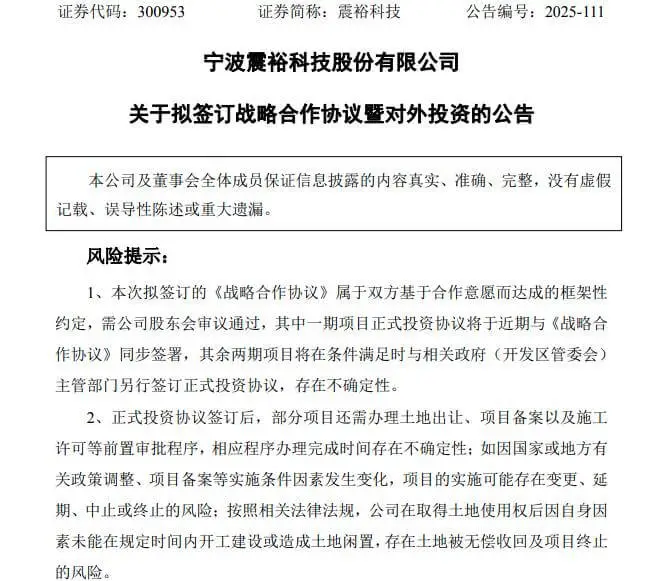
Meanwhile, the company is simultaneously advancing two major investment projects: its wholly-owned subsidiary, Suzhou Fanster, signed a strategic cooperation agreement with the Suzhou Science and Technology City Management Committee, planning to invest no less than 1 billion yuan in projects for core components of new energy vehicle drive systems, low-altitude aircraft drive systems, and embodied humanoid robot drive systems; and Ningbo Martin signed an investment agreement with the Xidian Town People’s Government of Ninghai County, planning to invest 1 billion yuan in the industrialization project of precision modules and components for humanoid robots.
Zhenyu Technology’s development trajectory perfectly mirrors the upgrading of China’s manufacturing industry – from low-end contract manufacturing to technological breakthroughs, from the domestic market to global competition, and from a single product to a complete industrial chain layout. The company has formed a development model “based on molds, with stamping and lithium-ion EV battery components as its two wings,” and now, humanoid robots are becoming the company’s “third wing.”
What exactly is the core product?
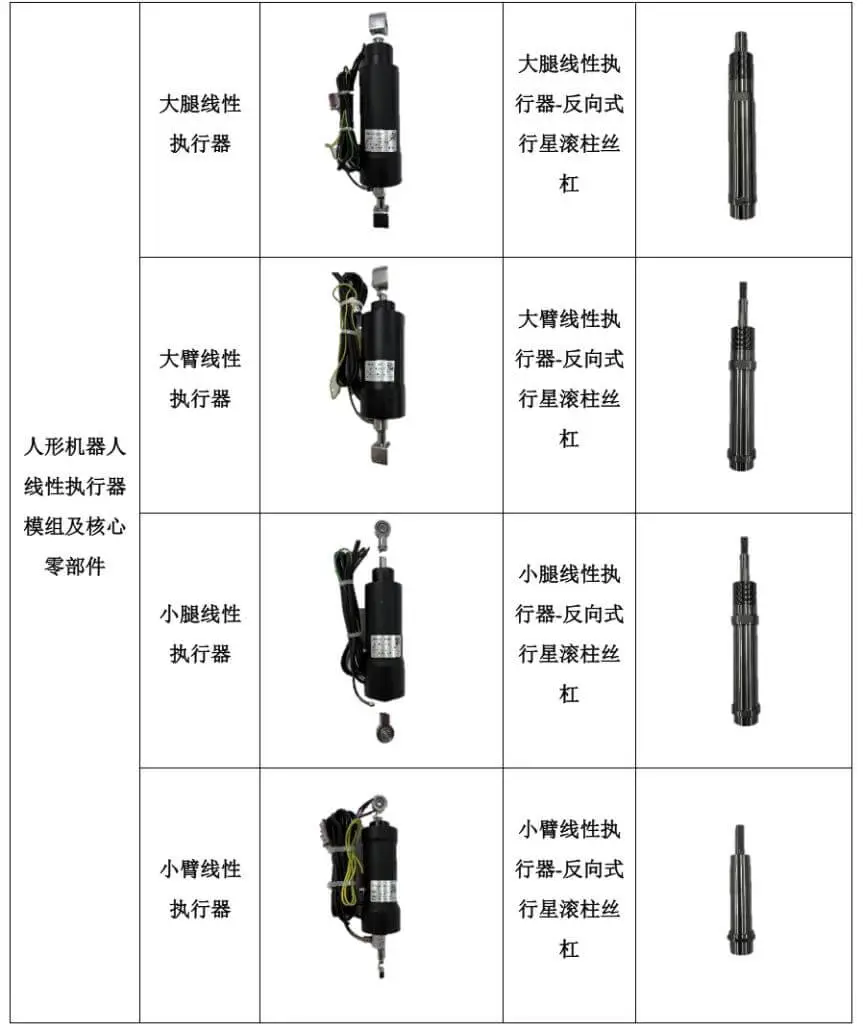
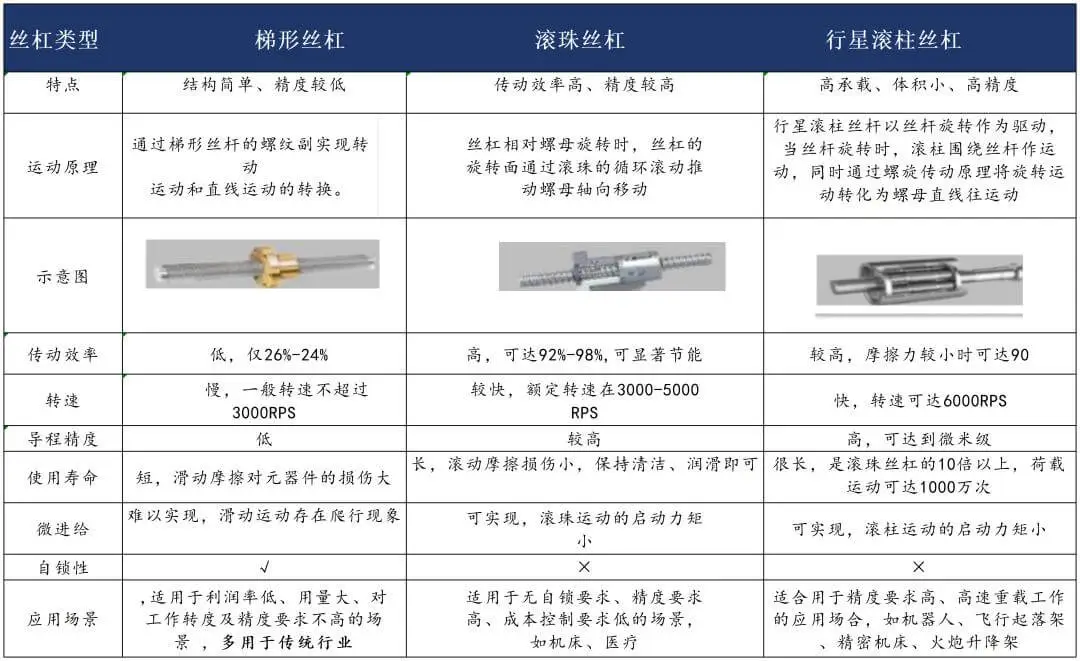
In the emerging field of robotics, Zhenyu Technology has developed three distinct product lines: reverse planetary roller screws, linear actuators, and precision components for dexterous robotic hands.
These products have been validated by several leading humanoid robot manufacturers both domestically and internationally, and some have already been delivered in small quantities.
Linear actuator modules and reverse-type planetary roller screws have been directly supplied to major overseas customers; domestic humanoid robot manufacturers that are currently using or developing these products have achieved comprehensive coverage in terms of mass production, sample delivery, and technical exchange.
It is worth noting that Zhenyu Technology’s robot products are undergoing rapid iteration.
The company focuses on the structural components, transmission mechanisms, and drive mechanisms of dexterous hands. Leveraging its precision manufacturing system in the mold industry and its years of experience in motor core stamping, Zhenyu Technology has developed the capability to mass-produce key components such as miniature roller screws, miniature ball screws, and worm gears.
From molds to robots, the leap may seem enormous, but the underlying technologies are actually the same. Zhenyu Technology’s core strength lies in its ultra-precision manufacturing capabilities accumulated over the past thirty years.
The company stated: “The robotics industry requires a large number of precision components, and there are many technical commonalities between its requirements in materials, heat treatment, manufacturing processes, specialized equipment development, assembly, and precision requirements, and those of our precision mold manufacturing.”
Even the most advanced algorithms still need mechanical structures to interact with and change the physical world. A slight inaccuracy in the lead screw, or a small decrease in the reliability of the robotic hand, can lead to vastly different performance from the robot. The next bottleneck in the industry is likely not in software, but in these fundamental “hard skills” related to mechanical engineering.
Based on this understanding, in the second half of 2023, the company began leveraging its strengths in ultra-precision manufacturing systems, processing technologies, material heat treatment, and processing equipment development to independently develop planetary roller screws required for humanoid robot linear joints, as well as other precision machined parts and motor components needed for humanoid robots.
The precision manufacturing system developed through years of experience in the field of precision progressive stamping dies ensures that the company can provide customers with comprehensive, integrated solutions. This represents a profound and difficult-to-replicate transfer of capabilities.
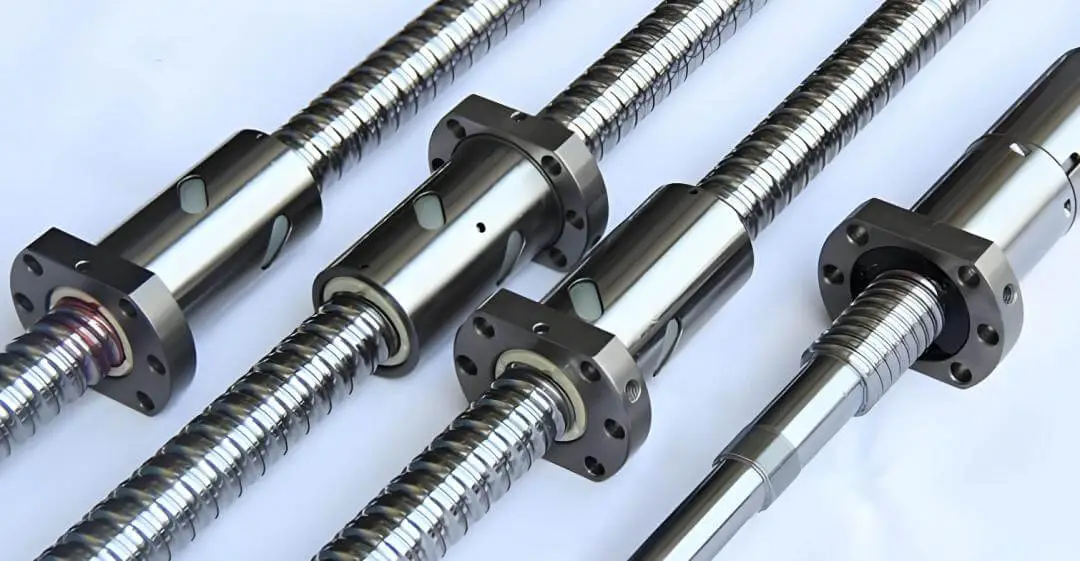
Specifically, for example, the reverse planetary roller screw, as a core component of linear actuators, directly determines the motion accuracy and load capacity of robot joints. The company has developed a complete set of standard products covering a peak thrust range of 100N to 12000N, with lead accuracy ranging from C3 to C5, and has successfully completed mass production SOP (Standard Operating Procedure) verification.
For example, the company’s linear actuators, built upon the industrialization of component products, have undergone accelerated system integration and are now in their third generation. Compared to the previous generation, they are 22.5% lighter, the actuator’s surface temperature during operation is reduced by 13%, and the module volume is reduced by more than 30%. The company possesses the capability for large-scale mass production, and the next generation of highly integrated modules is expected to be launched in the second half of 2025.
The dexterous hand’s precision components rely on the precision manufacturing system and motor resources of the mold industry, focusing on the design and production of structural components (framework), transmission mechanisms (miniature roller screws, miniature ball screws, etc.), and drive mechanisms (brushless slotted motors), forming a customized integrated solution.
The company has experienced the complete development cycle of the new energy electric vehicle industry and possesses extensive experience in ensuring consistent quality and continuous cost reduction through large-scale production of precision components—this is precisely the capability most needed for humanoid robots to transition from the laboratory to industrial production. Companies with a strong foundation in large-scale precision manufacturing have a unique head start in this marathon.
A production capacity plan of 210,000 units
Zhenyu Technology’s robotics strategy is not limited to the technological aspect; capacity building is also progressing simultaneously. According to the convertible bond fundraising plan, the first phase of the humanoid robot precision module industrialization project has a construction period of two years.
Upon completion and full production, the project is expected to achieve an annual production capacity of 210,000 sets of humanoid robot linear modules, 560,000 sets of planetary roller screws, 640,000 sets of miniature ball screws, and 40,000 pairs of dexterous hand transmission and structural components.
The company has made progress in expanding its planetary roller screw production capacity. On January 15, 2025, the company announced that it had successfully built and put into operation a semi-automatic production line for planetary roller screws, increasing its daily production capacity to 50 sets. A comprehensive testing laboratory for roller screws has also been established.
It is worth noting that Zhenyu Technology has completed the development of a complete set of standard ball screws, covering a peak thrust range from 100N to 12000N, with lead accuracy covering C3-C5, and has successfully completed mass production SOP verification.
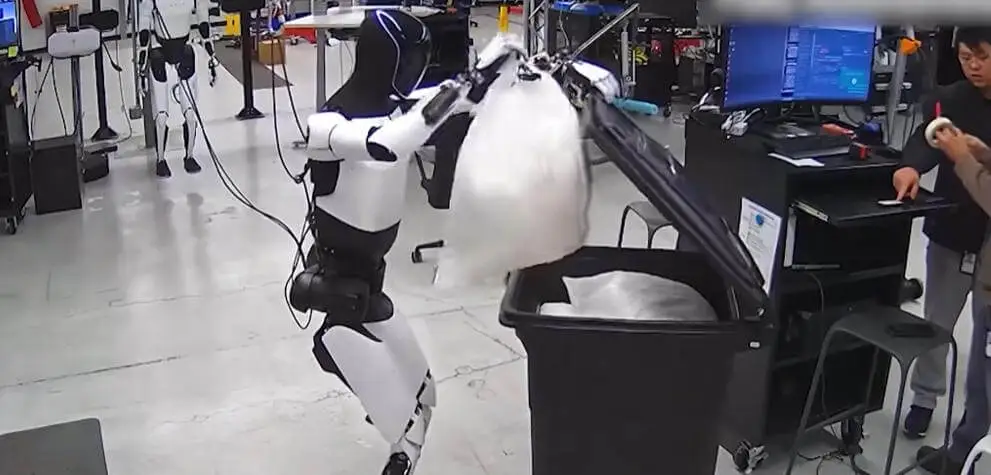
Zhenyu Technology is making a major foray into the humanoid robot field, driven by its strong optimism about the prospects of this sector. Humanoid robots are hailed as the “next disruptive intelligent terminal,” and global tech giants are all making strategic moves in this area.
During an institutional investor visit, the company stated that orders in the robotics industry have increased significantly since the fourth quarter, especially orders for dexterous hand components and assemblies. However, the company also acknowledged: “Our main business is quite large, and the revenue from robotics-related businesses still accounts for a relatively small proportion.”
This cautiously optimistic attitude is reflected in the company’s announcement: “The project construction will take a certain period, and there are still uncertainties regarding downstream demand. Currently, the revenue from the company’s robotics-related business accounts for a very small proportion, and it is expected that the company’s revenue structure will not change significantly in the short term after the project is completed.”
However, in the long run, Zhenyu Technology’s strategic positioning in the humanoid robot field is significant. On the one hand, the company can replicate its experience in large-scale production from the new energy vehicle sector to the robotics field; on the other hand, the demand for precision components in robots aligns perfectly with the company’s existing technological capabilities.
The announcement emphasized: “With the completion of the entire project and the improvement of capacity utilization, it will have a positive impact on Zhenyu Technology’s financial condition and operating results.” This is typical thinking for a company tempered by the manufacturing cycle: looking ahead to the future while steadily moving forward, without losing focus.
Moreover, their core business remains their top priority. Of the 1.88 billion yuan raised through convertible bonds, the majority (752 million yuan) will still be invested in expanding the production of lithium battery components to meet the explosive demand from the downstream energy storage and electric vehicle sectors. They predict that this business will continue to experience strong growth next year.
Conclusion and Future Directions
In Zhenyu Technology’s Phase III investment plan in Ninghai, the robotics project covers an area of 118 mu (approximately 7.8 hectares) with a planned building area of 160,000 square meters. It will primarily be responsible for the research and development and production of core components for humanoid robots.
Meanwhile, the company’s factory in Serbia officially began operations in November of this year, primarily focusing on the stamping of motor core components, with space reserved for expanding into other business areas.
After achieving success in the new energy vehicle sector, this hidden champion is attempting to replicate its success in the robotics field. Can it become a key supplier of joints for the humanoid robot industry? The market is waiting for the answer.