

Home / Ceramic Bearings / Hybrid Ceramic Bearings
Hybrid Ceramic Bearings
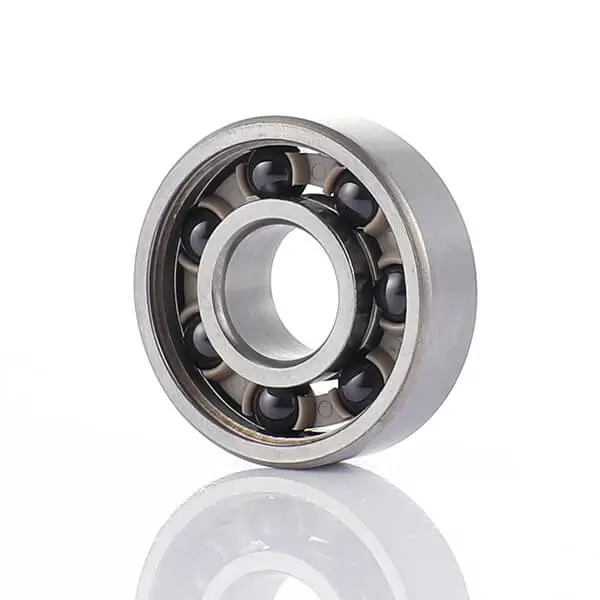
Hybrid ceramic bearings combine of steel rings with the advanced properties of silicon nitride ceramic balls.
Unlike full-ceramic bearings (which can be brittle under impact), hybrids offer exceptional speed capability, lower heat generation, electrical insulation, and excellent corrosion resistance.
ZMS is a professional hybrid ceramic bearings supplier in China. Chrome steel or stainless steel rings +peek or brass or steel cage+ceramic balls many options for choose.
Modals:
Hybrid deep groove ball bearings
Hybrid cylindrical roller bearings
The Best of Both Worlds: Steel Toughness meets Ceramic Precision
ZMS hybrid ceramic bearings are engineered to push the limits of standard machinery. They feature inner and outer rings made of premium, vacuum-degassed bearing steel (or stainless steel) combined with rolling elements made of Silicon Nitride (Si3N4) bearing-grade ceramic. This perfect hybrid construction provides the heavy load-carrying capacity of steel alongside the ultra-low friction and electrical resistance of ceramic.
Eliminating Electrical Pitting in VFD and EV Motors
With the rapid rise of Variable Frequency Drives (VFD) and Electric Vehicle (EV) motors, high-frequency stray currents have become a major cause of premature bearing failure, known as electrical fluting or pitting.
Because Si3N4 ceramic balls are naturally electrically insulating, ZMS hybrid ceramic bearings completely break the electrical path between the rotor and stator. This completely eliminates arcing damage, saving your motors from catastrophic failure without the need for expensive insulated coatings.
Engineered for Ultra-High Speeds and Lower Operating Temperatures
Ceramic balls are approximately 40% less dense than steel balls. This dramatic reduction in weight significantly decreases the centrifugal forces applied to the outer raceway when spinning at extreme speeds.
Coupled with the incredibly smooth surface finish of ceramic, our hybrid bearings operate with significantly lower friction. This results in lower operating temperatures, allowing machine tool spindles and turbochargers to achieve up to 30-50% higher RPMs while dramatically extending the life of the lubrication grease.
Superior Wear Resistance and Extended Fatigue Life
Silicon nitride is significantly harder than bearing steel. If hard contaminant particles enter the raceway, the Si3N4 balls effectively crush them, preventing the particles from denting the raceways. Additionally, unlike steel-on-steel contact, steel-on-ceramic contact eliminates the risk of micro-welding (adhesive wear/galling) during marginal lubrication conditions, ensuring a substantially longer fatigue life.